
Africa Forum 2018
Be the Legacy: A celebration of hope and human creativity
Commemorating the Nelson Mandela centenary
University of Basel, 13 September 2018
2018 marks the centenary of President Nelson Mandela’s birth, one of Africa’s greatest leaders. His life and work stand not only for the resilience of the South African people, but also for the deeper significance Africa’s experience has to the whole world.
Colonialism and racial discrimination were not simply crimes against Africans. They were grave violations of the values and principles by which mankind wishes to be judged. In fighting to end colonialism and racial discrimination, South Africans appealed to higher human values and placed a mirror in front of the world so that it could see itself when bigotry and hatred are allowed to flourish. With his commitment to reconciliation and forgiveness, President Nelson Mandela reminded us all that we are one big family founded on values that transcend local cultures and particular interests.
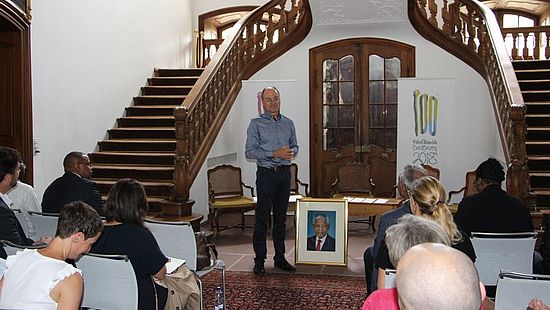
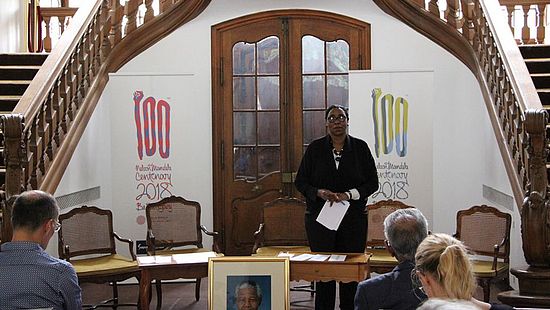
On 13 September 2018, the Embassy of the Republic of South Africa and the Centre for African Studies of the University of Basel celebrated the hope and human creativity represented by President Nelson Mandela’s political legacy. They brought together scholars with a broader Swiss public to reflect on the meaning of the struggle for freedom and human dignity in South Africa and the lessons to be learned for Swiss and European debates.
Roundtable
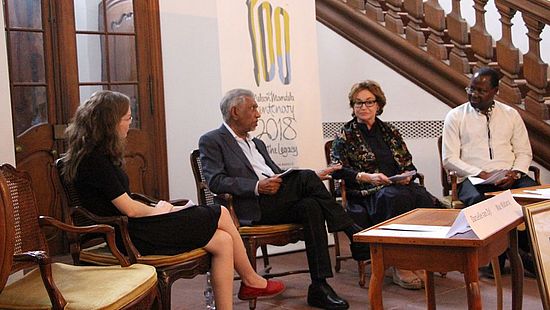
Making a DifferenceSathyandranath “Mac” MaharajAs a member of the National Executive Committee of the African National Congress (ANC), its armed wing Umkhonto weSizwe, and of the South African Communist Party, Mac Maharaj played a pivotal role in South Africa’s liberation struggle. He was imprisoned in Robben Island alongside Nelson Mandela and later lived in exile. As secretary of the Convention for a Democratic South Africa (CODESA), Mac Maharaj was involved in negotiations on the transition from apartheid to democracy. He became Minister of Transport in South Africa’s first democratically elected government and, later, a director at FirstRand Bank and spokesperson of former President Jacob Zuma. Reflections in PrisonWhile imprisoned on Robben Island, Nelson Mandela and several of his comrades wrote essays on South Africa’s political future. Fellow prisoner Mac Maharaj smuggled the manuscripts out and published them in the volume Reflections in Prison: Voices from the South African liberation struggle. The essays, written by Nelson Mandela, Walter Sisulu, Govan Mbeki and others, offer insights into the ideas, strategies and hopes of some of the most important anti-apartheid movement leaders on the eve of the 1976 Soweto uprising. We discuss the essays and their meaning for the present and future in South Africa and beyond with the editor, Mac Maharaj. Discussants:Elísio Macamo, Professor for African Studies/Director of the Centre for African Studies, University of Basel Therese Steffen, Professor for English literature em., University of Basel Danelle van Zyl, postdoc fellow, Department of History, University of Basel |
Panel
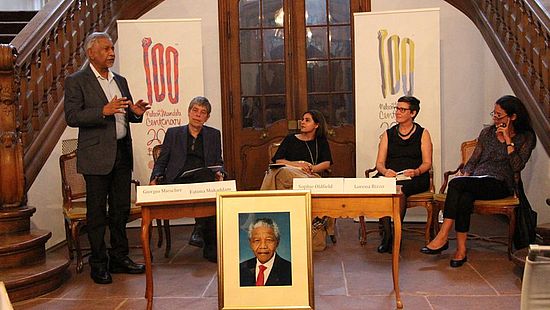
Celebrating Hope and Human CreativityThis panel offers an opportunity to reflect about manifestations of and inspirations for hope and creativity in the long struggle to overcome apartheid and the short history of democratic South Africa. Scholars relate to their own research on South Africa and beyond in order to discuss with what we can learn from the South African experience. PanelistsGiorgio Miescher, senior lecturer, Centre for African Studies Basel Fatima Mukaddam, PhD candidate, University of Luzern Sophie Oldfield, Professor of Urban Studies, Universit of Basel and University of Cape Town Lorena Rizzo, senior lecturer, Centre for African Studies Basel |
Concert
The Swiss-South African Jazz QuintetSince Feya Faku’s 2006 residency at the bird’s eye jazz club in Basel, this band has performed the music of its leader—based as much in Hardbop as in the music traditions of the Eastern Cape. The outstanding vocalist Siya Makuzeni, the sensitive pianist Jean-Paul Brodbeck, the grooving bass of Fabian Gisler and Dominic Egli on drums provide an ideal rhythm section that equally supports and challenges. Line-upSiya Makuzeni (vocals/bow/trombone) |