
New Publications
/ Research
Publication: "Pesticide exposure among organic and conventional smallholder farmers in Costa Rica and Uganda: biomarker evidence on exposure determinants"
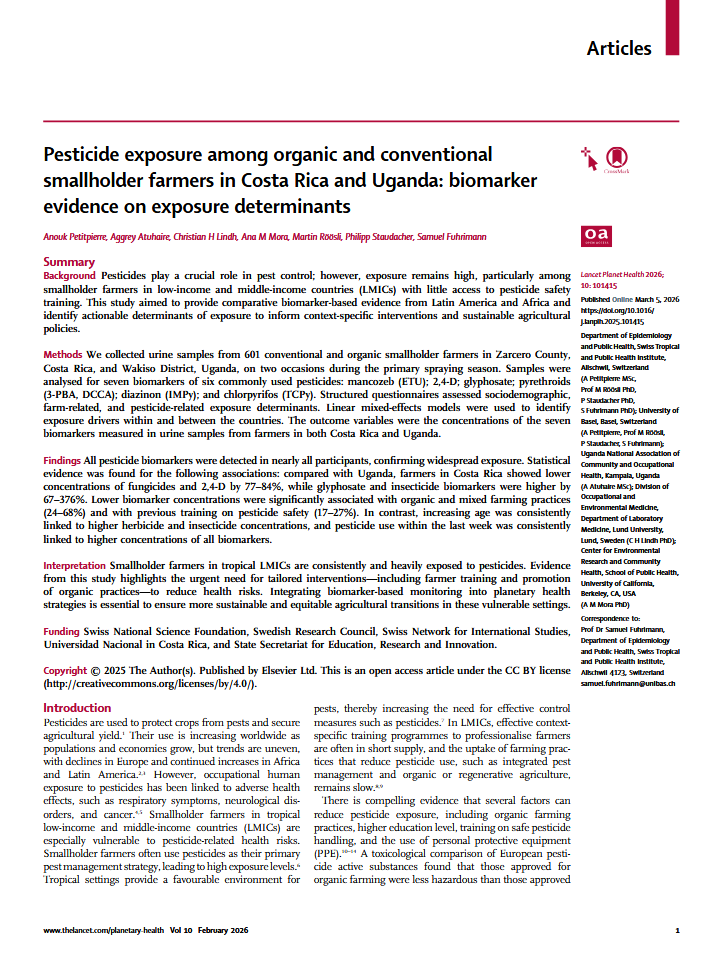
A study in Costa Rica and Uganda co-authored by Martin Röösli and Samuel Fuhrimann shows pesticide exposure is widespread among smallholder farmers but can be reduced through organic farming and safety training.
Abstract – Summary
Background
Pesticides play a crucial role in pest control; however, exposure remains high, particularly among smallholder farmers in low-income and middle-income countries (LMICs) with little access to pesticide safety training. This study aimed to provide comparative biomarker-based evidence from Latin America and Africa and identify actionable determinants of exposure to inform context-specific interventions and sustainable agricultural policies.
Methods
We collected urine samples from 601 conventional and organic smallholder farmers in Zarcero County, Costa Rica, and Wakiso District, Uganda, on two occasions during the primary spraying season. Samples were analysed for seven biomarkers of six commonly used pesticides: mancozeb (ETU); 2,4-D; glyphosate; pyrethroids (3-PBA, DCCA); diazinon (IMPy); and chlorpyrifos (TCPy). Structured questionnaires assessed sociodemographic, farm-related, and pesticide-related exposure determinants. Linear mixed-effects models were used to identify exposure drivers within and between the countries. The outcome variables were the concentrations of the seven biomarkers measured in urine samples from farmers in both Costa Rica and Uganda.
Findings
All pesticide biomarkers were detected in nearly all participants, confirming widespread exposure. Statistical evidence was found for the following associations: compared with Uganda, farmers in Costa Rica showed lower concentrations of fungicides and 2,4-D by 77–84%, while glyphosate and insecticide biomarkers were higher by 67–376%. Lower biomarker concentrations were significantly associated with organic and mixed farming practices (24–68%) and with previous training on pesticide safety (17–27%). In contrast, increasing age was consistently linked to higher herbicide and insecticide concentrations, and pesticide use within the last week was consistently linked to higher concentrations of all biomarkers.
Interpretation
Smallholder farmers in tropical LMICs are consistently and heavily exposed to pesticides. Evidence from this study highlights the urgent need for tailored interventions—including farmer training and promotion of organic practices—to reduce health risks. Integrating biomarker-based monitoring into planetary health strategies is essential to ensure more sustainable and equitable agricultural transitions in these vulnerable settings.