
Dr. Julia Rensing
Postdoc im Projekt Inherited Futures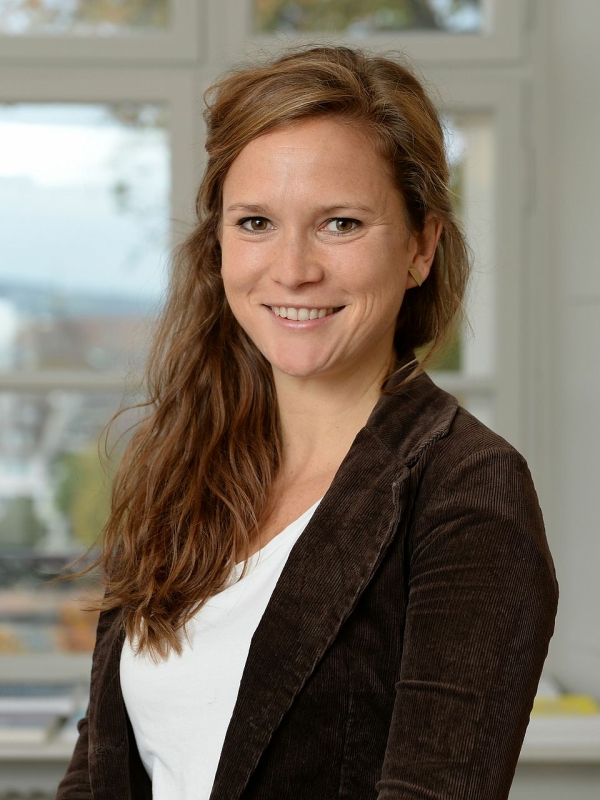
Postdoc im Projekt Inherited Futures
Rheinsprung 21
4051 Basel
Schweiz
Profil
Julia Rensing is a postdoctoral researcher at the Centre for African Studies at the University of Basel, Switzerland. In her current research as part of the project “Inherited Futures? Objects, Time, Knowledge” she explores how material objects such as archival letters and photographs preserve and transport knowledges and how their meanings transform through circulation processes. She is also interested in the more abstract and immaterial dimensions of inheriting, which figure, for example, in inherited injustices and the archival formations of this. In her book Troubling Archives: History and Memory in Namibian Literature and Art (transcript, 2025) Rensing engages more deeply with discourses on archives as sites of knowledge production and contestation. The book focuses on the role of photographic archives and explores how contemporary authors and artists from Namibia use photography as a way to make sense of the country’s complex colonial history. More broadly, Rensing is interested in how artistic practices shape discourses on (de)coloniality, inheritance, memory and imagined futures. She is also a member of the initiative Freiburg-Postkolonial, a research and educative project which promotes public debates about the colonial legacies of Freiburg and beyond.
Publications
Forthcoming publications
Rensing, J. (accepted). On opacity and empathy: A conversation with Tuli Mekondjo on art beyond violence. In K. Shinners (Ed.), Full Stop Quarterly: Contradictions of Looking.
Journal articles
Rensing, J., & Stodel, S. (2026). Overwhelming inheritance: Family pictures in Sitaara Stodel's photo-collages. Safundi, 27(1), 145–159. https://doi.org/10.1080/17533171.2025.2565030
Rensing, J. (2022). 'Ovizire ∙ Somgu: From where do we speak?' (2018–2020): Artistic interventions in the Namibian colonial archive.Journal of Southern African Studies, 48(1), 81–102. https://doi.org/10.1080/03057070.2022.2021737
Books
Rensing, J. (2025). Troubling archives: History and memory in Namibian literature and art. transcript Verlag.
Rensing, J. (Ed.), Rizzo, L. (Ed.), & Rutishauser, W. (Ed.). (2021). Sites of contestation: Encounters with the Ernst and Ruth Dammann Collection in the Archives of the Basler Afrika Bibliographien. Basler Afrika Bibliographien.
McBride, S.-L. (Ed.), & Rensing, J. (Ed.). (2023). Lost libraries, burnt archives. Michaelis Galleries.
Book chapters
Rensing, J. (2026). Where the birds hover—Spirits, loss, and ancestral echoes: Tuli Mekondjo. In N. Guyer (Ed.), A kind of paradise: Artistic counter-narratives to colonial-era photography (pp. 128–130). Spector Books.
Rensing, J., & Kandemiri, C. (2023). Imaginations and constructions of literary spaces: The Lower ǃGarib / Orange River region in literature. In L. Lenggenhager, M. Akawa, G. Miescher, R. Nghitevelekwa, & N. I. Sinthumule (Eds.), The Lower ǃGarib – Orange River: Pasts and presents of a Southern African border region (pp. 65–78). transcript Verlag. https://doi.org/10.14361/9783839466391-004
Rensing, J. (2023). “Contested memories and spaces: Art, archives, and ambivalence in Ovizire ∙ Somgu: From where do we speak?” In S. Hegenbart (Ed.), Curating transcultural spaces: Post-colonial conflicts in museological perspectives (pp. 109–130). Bloomsbury Academic.
Rensing, J. (2023). “Lost or found: Reckoning with archival ruins.” In S.-L. McBride & J. Rensing (Eds.), Lost libraries, burnt archives (pp. 60–85). Michaelis Galleries.
Rensing, J. (2021). “Worlds apart? Biographies and interventions in the Dammann Collection.” In J. Rensing, L. Rizzo, & W. Rutishauser (Eds.), Sites of contestation: Encounters with the Ernst and Ruth Dammann Collection in the Archives of the Basler Afrika Bibliographien (pp. 29–54). Basler Afrika Bibliographien.
Magazine article
Rensing, J. (2020, November/December). „Fest auf dem Sockel: Der Schädelsammler Alexander Ecker wird in Freiburg noch immer geehrt.“ iz3w: Informationszentrum Dritte Welt, 381, 14–16.
Podcast Interview:
New Books Network, hosted by Jen Hoyer. Conversation on: “Troubling Archives. History and Memory in Namibian Literature and Art” 2025.